


Ebb and flow
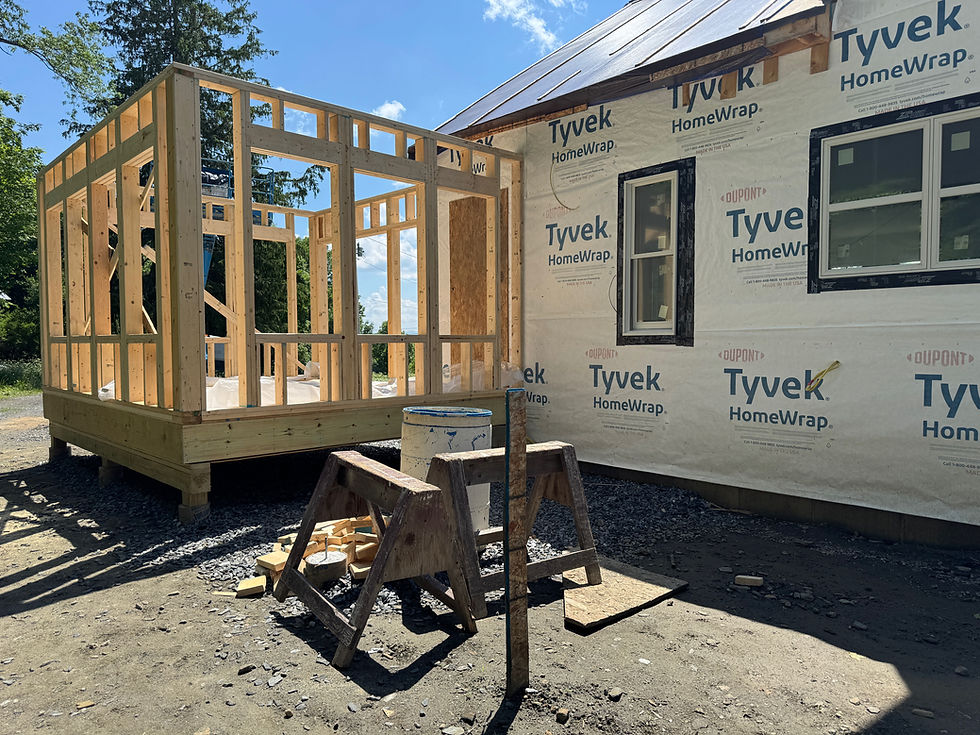
I have only recently realized that building a house (i.e. having a house built) takes patience and a sort of fortitude.
Most people seem to realize this instinctively. They say things like, “Wow! You’re building a HOUSE?!” or “Isn’t it nerve-wracking?!!” or “I could never handle all of the decisions!”
Instead, I don’t want to brag, but I walked into this as naturally as opening the front door and stepping out. Obviously, you must go down the walkway and head for the open road. No problem!
Now I am finally experienced enough that I am ready to list the requirements needed to build a house:
1. One must remain calm.
Anxiety runs in my family. We are the sorts of people who gasp too often, you know- that sudden intake of breath alerting a companion to a dangerous situation (prematurely or unnecessarily). Any spouse to one of my sisters will know what I mean.
For some reason, in this sort of house building/working situation that involves planning, my desire to organize jumps in and I remain strangely calm.
2. One must not get bored easily.
I think, partly because I am a hyper-sensitive person, I get excited by small changes, it doesn’t take much to keep me interested.
I am energized by research. I have always loved recording data. When I was 11, I sat and watched birds from my bedroom window and keep a notepad where I recorded all of my observations. I have been happy doing that ever since.
As an insecure 12-year-old, I would list my clothes for the next school day, complete with drawings of patterned stockings that went up just over the knee.
I kept data on my new baby son more than just the usual baby book fill-ins. Poor kid.
I was fortunate to work in a university research lab, collecting data on insect behavior.
I am never happier than when I have a decision to make. But first I want to base it on the best information. These days research is made easy on a laptop. I compile it, organize it into tables along with pros and cons, screen-shot photos, and then come up with my final determination.
3. One must have low expectations.
You are on timelines that are not your own. It’s an intricate dance of the general contractor, carpenters, subcontractors, architectural designer, homeowner/bill payer/decider, along with the weather and everyone’s health.
Until recently, waiting came easily since I could always be creating a 50-page document on all of the materials I preferred for the house. From exterior siding down to the type of knobs for kitchen cabinets, there was always something to research, something to do while I was waiting.
Until recently. The timeline is slowing down now. If it was a piece of classical music you’d hear it. It would have a notation of “Rallentando implying a dramatic, drawn-out deceleration.” If you were driving a car, you’d hear the engine suddenly slowing down, RRRrrrrrrrrrrrrrrr as if a traffic jam was just ahead.
So now I must learn patience. I was getting greedy. I wanted to see Progress! Photos! Exciting news!
4. One must be a good communicator.
I have pretty decent social skills. I can interpret body language, anticipate problems, jump in to negotiate, work at calming agitation between others. (Maybe this is my teacher training.) I have had multiple bouts of having to do this with the people involved in the house building.
Some people have a hard time maintaining a professional demeanor or civilly explaining an issue. I think this is true whenever money gets involved. As my builder says “I never want to go backwards and have to redo something. This costs money!”
Don’t assume a text on your telephone ‘works’. As anyone who has experienced a misinterpreted text- typed words on a phone do not do justice to the English language. An added smiley face can help but often the receiver is more than ready to ‘hear’ the person yelling even when they are not.
I am now ready to call people more often. Phone calls can prevent misinterpretations that texts can cause. Phone calls will bring to the forefront questions people have. Phone calls spell out details much better than any text.
The reason I have used texts- I didn’t want to bother someone. I end up with a record of what was said. I could immediately take care of a question I have without forgetting to ask it.
But if this causes problems, then I will move on to telephone calling. My new norm.
Don’t assume your builder always has the plans in front of him or even easily available. Check in often. Ask questions. Follow up.
5. One must be a good listener.
The builder and architectural designer can have issues over the house design. These are not always brought up at the beginning of a project, but instead as the project enters certain critical phases. Not being an architect or a builder, you won’t be able to anticipate when those critical times will occur.
The architectural designer often has artistic abilities. This is good; you want a house with great style. They also get attached to their design. That makes sense. They put in a lot of time on their floorplans and elevations. They have worked hard to implement the desires of the homeowner. Now their job is to make sure those designs are fulfilled. This is an architect that has your interest in mind. Especially when you can’t be at the site daily, it is nice to have someone keeping an eye on the project.
But builders have a lot of expertise too. They have years of seeing the buildings in real life. They see how all of the parts fit together properly. They know how to make a house work. They can foresee issues that could occur once you are living in a house and in all kinds of weather. They can change gears on a plan to prevent those inconveniences or damages. They make a house truly livable.
So, you have to take both viewpoints (designer & builder) into account and make sure you are aware of when disagreements happen. Sometimes both the architect and the builder are so sure of their viewpoint, they figure they don’t have to ask you, the homeowner who knows nothing of either area of expertise. Instead, they argue it out between themselves. So it’s a good idea to reiterate to both…”Please call me…please ask me. Let me decide which viewpoint is more important to me.”
Let me give you an example from the last two weeks. The Porch Controversy. Something was going on that I couldn’t quite pick up on. Suddenly my builder was acting weird. He was smoldering somewhat quietly. He wanted me to come up and look at the porch, but somehow couldn’t tell me what the problem was.
Miscommunication. The first part was my fault when I asked if everyone thought the porch posts were too spindly-looking on the design drawing. YOU DON’T ASK TO CHANGE COURSE WHEN YOU ARE THAT FAR INTO A PROJECT! I know, you should be able to. And many builders will even say “It’s great, you can change your mind as we go along and we can adapt things to be the way you want!!” But if I could have predicted the problems that ensued from that innocent question, I never would have asked.
If you don’t ask the question to both people involved at the same time, different interpretations can be made. One person thinks…no they aren’t too spindly and they will work out fine once they are there. Another thinks, oh! Sylvia wants thicker posts! Disagreements between those two people start to happen without you there and without a true consultation (misinterpreted unclear texts occur from me to builder). Thicker posts go up. Thicker posts come down.
Long story short. The post controversy is over now and the porch is looking spectacular.
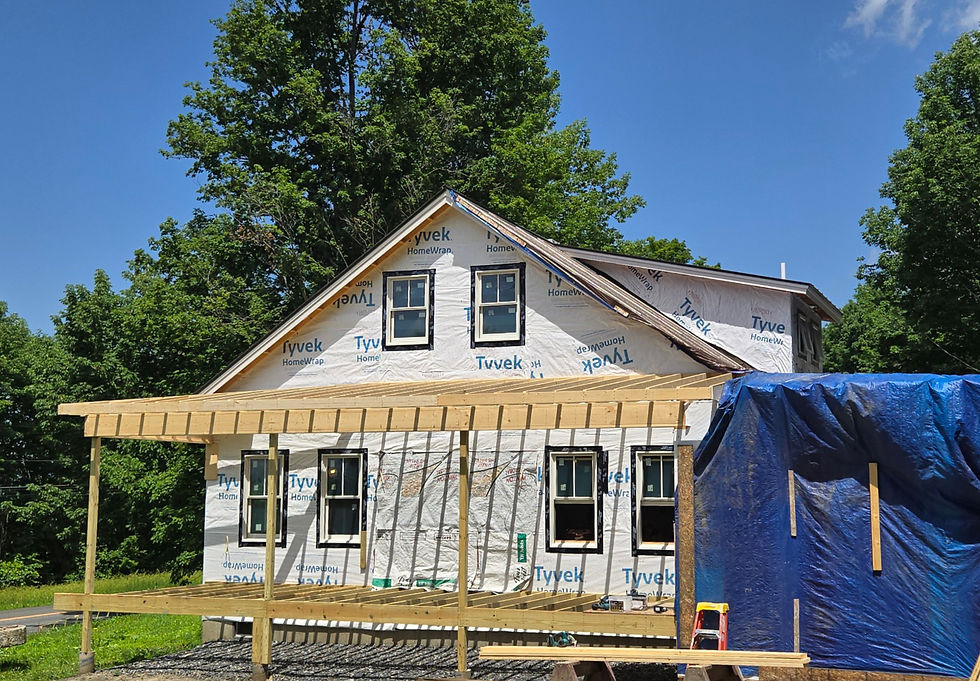
Then there is the fairly flat angle of the porch roof and the 4-season-room roof. The roofline is beautiful in two ways- it looks simple and it won’t stop the winter sun from coming in and lighting up the rooms. But from a practical perspective, flat in Vermont means snow sitting on it. The builder has a point. Snow on a roof can translate into leaks. But too late, the roof is there. But why didn’t he ask me? He hashed it out with the architect and the formerly agreed-upon design won out.

So dear reader, future builder of houses, I give you way too much information here to save you possible problems with your own project. They aren’t big problems. They probably won’t even matter in the long run. But if I can possibly help you out, then I feel I should.
My builder is also moving on with other work- another foundation on another new house. You can’t hold a builder captive. They need to balance their work as they see fit. And I did say “we are in no rush.” Ha ha hahahah. I have to keep that other woman at bay, the one inside me that wants it and wants it now! Like I said, I have gotten greedy and the project that was working so seamlessly and joyfully has become just a bit harder for me. But I am also one of those people that feel that all of life is a learning experience. I am learning how to make this work.
6. One should meet with anyone involved in a project TOGETHER, not separately.
No matter how many times you meet with someone, there is nothing that can replace a group meeting where all involved study the plans ahead of time. I would suggest looking at every single elevation and floorplan asking, “What do you see here? Will it work in practice? What would you change to have it function better?”
7. One should not take comments as promises written in stone.
A comment like “I’m hoping to have this all sewn up by August.” means just that. Hoping. Thinking aloud at that moment.
A comment that follows after your flooring appointment when you have chosen the materials. The flooring contractor says he will get right on it doesn’t mean it will happen right away. As the homeowner you won’t be aware of all that needs to happen first:
The builder has to finish the last bit of mudding, taping, and painting of the mudroom that he is leaving for a rainy day. He will do all of the wood work around windows and doors and paint/install interior doors. Maybe even the bathroom vanities will be in first. Maybe even the kitchen cupboard bases. So maybe flooring will happen in November.
But in the meantime, I will get to see all that!? That’s good!
8. One should start organizing one’s life in the current (old) house to be ready to move when the new house is ready!
But that is drudgery, right? I guess any project can’t be all fun.


Comments